
Orchestration of extracellular matrix organization, what’s going on here?
We are a multidisciplinary group studying tissue organization at the CeMM Research Center for Molecular Medicine. We exist at the interface of engineering and biology and we are driven by the questions: how do cells use the extracellular matrix and mechanical forces to collectively coordinate, initiate, and maintain tissue organization? what happens when forces are too much to handle? how do multicellular systems budget their metabolic needs to organize?
We particularly focus on how local mechanical conditions instruct tissue organization through global morphological and cell state changes, but also tissue disorganization in conditions such as traumatic brain injuries. We take three approaches to address this (1) we engineer our own platforms to mechanically stimulate and measure local and emerging mechanical properties in tissues, (2) we explore mechanobiology across the scales in-vitro, going from multicellular events to molecular drivers (genes and metabolites), in order to characterize and study the dynamic relationship between cells and their extracellular matrix (ECM) microenvironment, (3) we develop computational models to explore the physical laws and logic used by cells to organize, in our effort to establish the mechanical roadmap to tissue organization. Along the way we aim to explore the mechanics of the Dark Morphospace, which will reveal a wealth of alternative morphogenesis to build new/better tissues, tricks to avoid diseases, and teach us about the robustness of our own biology.
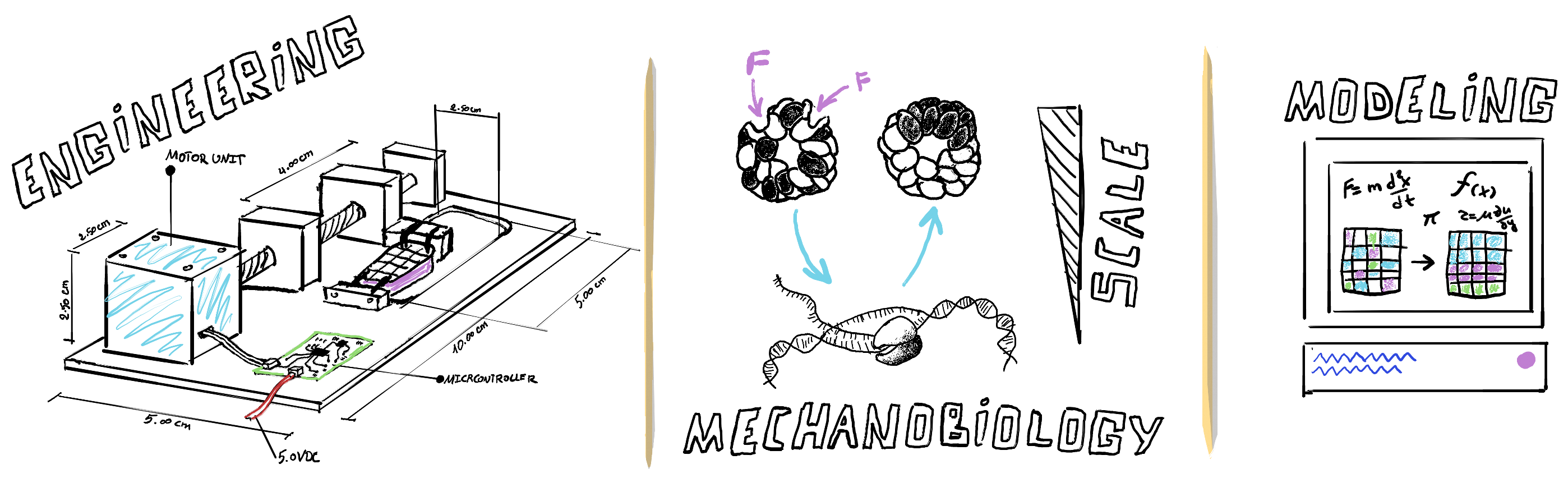
In our quest to answer these questions we use magnetic and fluid/solid mechanics engineering principles to build tools that allow us to locally mechanically stimulate cells, deliver traumatic injuries as well as measure local mechanics. Next we focus on quantifying multicellular dynamic cell-ECM interactions using a combination of time-lapse microscopy, high content image analysis, and neighborhood analyses. We explore the driving molecular programs that drive these interactions by combining transcriptomics and metabolomics with mechanical data in mechano-omics maps. Finally, we describe the organization strategies employed by cells from a mechanical standpoint through computational models using positional information, cellular automata and reaction diffusion models.
Our main research topics include central nervous system health, traumatic brain and spinal cord injuries, and liver fibrosis. We utilize several in-vitro model systems, with a primary focus on those derived from human pluripotent stem cells.
Learn more about our research
 Abdel Fattah Lab